Free PDF Linux+ Guide to Linux Certification, by Jason W. Eckert, M. John Schitka
There is no doubt that publication Linux+ Guide To Linux Certification, By Jason W. Eckert, M. John Schitka will constantly give you inspirations. Also this is just a publication Linux+ Guide To Linux Certification, By Jason W. Eckert, M. John Schitka; you could find lots of genres as well as kinds of publications. From amusing to adventure to politic, and sciences are all given. As just what we mention, right here we offer those all, from famous writers as well as author worldwide. This Linux+ Guide To Linux Certification, By Jason W. Eckert, M. John Schitka is one of the collections. Are you interested? Take it now. Exactly how is the way? Find out more this article!
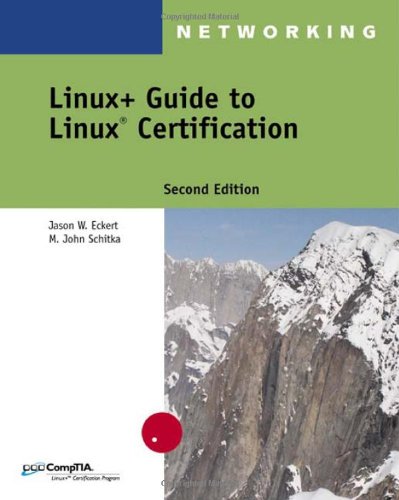
Linux+ Guide to Linux Certification, by Jason W. Eckert, M. John Schitka

Free PDF Linux+ Guide to Linux Certification, by Jason W. Eckert, M. John Schitka
Linux+ Guide To Linux Certification, By Jason W. Eckert, M. John Schitka. In undertaking this life, lots of people always try to do as well as obtain the ideal. New expertise, encounter, session, and every little thing that could improve the life will be done. Nonetheless, many individuals in some cases feel perplexed to get those points. Really feeling the minimal of encounter as well as sources to be much better is one of the lacks to possess. However, there is an extremely straightforward thing that can be done. This is just what your teacher consistently manoeuvres you to do this one. Yeah, reading is the answer. Reviewing a book as this Linux+ Guide To Linux Certification, By Jason W. Eckert, M. John Schitka and other referrals can improve your life quality. How can it be?
By checking out Linux+ Guide To Linux Certification, By Jason W. Eckert, M. John Schitka, you could understand the expertise as well as things more, not just regarding exactly what you get from people to individuals. Reserve Linux+ Guide To Linux Certification, By Jason W. Eckert, M. John Schitka will certainly be more trusted. As this Linux+ Guide To Linux Certification, By Jason W. Eckert, M. John Schitka, it will really provide you the smart idea to be effective. It is not just for you to be success in particular life; you can be successful in everything. The success can be started by understanding the standard understanding as well as do actions.
From the mix of knowledge as well as activities, a person can improve their ability and capacity. It will certainly lead them to live as well as function much better. This is why, the students, workers, and even companies should have reading habit for publications. Any type of publication Linux+ Guide To Linux Certification, By Jason W. Eckert, M. John Schitka will offer specific understanding to take all perks. This is exactly what this Linux+ Guide To Linux Certification, By Jason W. Eckert, M. John Schitka tells you. It will certainly add more expertise of you to life as well as function far better. Linux+ Guide To Linux Certification, By Jason W. Eckert, M. John Schitka, Try it and verify it.
Based on some encounters of lots of people, it remains in reality that reading this Linux+ Guide To Linux Certification, By Jason W. Eckert, M. John Schitka can help them making better choice and offer even more encounter. If you intend to be one of them, allow's purchase this book Linux+ Guide To Linux Certification, By Jason W. Eckert, M. John Schitka by downloading and install the book on web link download in this website. You can get the soft documents of this publication Linux+ Guide To Linux Certification, By Jason W. Eckert, M. John Schitka to download and install and deposit in your available digital tools. Just what are you awaiting? Allow get this publication Linux+ Guide To Linux Certification, By Jason W. Eckert, M. John Schitka online as well as review them in any time and any type of place you will read. It will not encumber you to bring heavy publication Linux+ Guide To Linux Certification, By Jason W. Eckert, M. John Schitka within your bag.
Linux+ Guide to Linux Certification, Second Edition offers the most up-to-date information which empowers students to successfully pass CompTIA's Linux+ Certification exam. CompTIA has revised their Linux+ Certification to meet industry demands by reducing its focus on hardware terminology and increasing its focus on the configuration of network services and security. In addition, the entire text has been updated for use with Red Hat Fedora Core 2, the newest version of the popular Linux Operating System. Not only will this prepare users for CompTIA's Linux+ Certification, this text will equip all users with the information necessary to remain current with industry changes.
- Sales Rank: #1859791 in Books
- Brand: Brand: Cengage Learning
- Published on: 2005-04-06
- Original language: English
- Number of items: 1
- Dimensions: 1.61" h x 7.32" w x 9.24" l, 3.00 pounds
- Binding: Paperback
- 767 pages
- Used Book in Good Condition
Review
1. Introduction to Linux 2. Preparing for Linux Installation 3. Linux Installation and Usage 4. Exploring Linux Filesystems 5. Linux Filesystem Management 6. Linux Filesystem Administration 7. Advanced Installation 8. Working with the BASH Shell 9. System Initialization and X Windows 10. Managing Linux Processes 11. Common Administrative Tasks 12. Compression, System Backup, and Software Installation 13. Troubleshooting and Performance 14. Network Configuration 15. Configuring Network Services and Security Appendices A: Certification B: GNU Public License C: Finding Linux Resources on the Internet
About the Author
Jason W. Eckert is an experienced technical trainer, consultant and best-selling author in the Information Technology (IT) industry. He has more than 20 IT certifications, 25 years of IT experience, four published apps, and 22 published textbooks covering topics such as UNIX, Linux, Apache, MySQL, Windows Server, Security, Microsoft Exchange, PowerShell, BlackBerry Enterprise Server, and Video Game Development, to his credit. Mr. Eckert brings the value of his diverse IT experience and expertise to every class that he teaches at triOS College. He also serves as the Dean of Technology at triOS College, where he continues to refine and improve college technology programs. For more information about Mr. Eckert, visit about.me/jasoneckert.
A graduate of McMaster University, M. John Schitka is a former instructor at triOS College. Initially teaching NT4 technologies, he currently conducts courses on Windows 2000, UNIX, Linux, and more.
Most helpful customer reviews
0 of 0 people found the following review helpful.
Great for a textbook
By Devin Stephens
Use: Purchased for School as a used book
Short Review: Price was great (for used books) and the quality and condition is excellent.. So far, the book is well written and easy to follow.. The book includes a copy of Linux, however, I did decide on another version of Linux for my class.. No issues there. So far, I have learned a lot from the book! It doesn't read like a textbook but more like an instruction manual which I like..
Overall: I probably wouldn't have purchased this if it wasn't for school, but I am enjoying the book for what it is so far
0 of 0 people found the following review helpful.
Great price and wonderful for a noob like me
By Marduk73
I've been afraid of Linux for over 10 years. I was always interested but also scared off. I kept breaking it. Then again, that's how I learned Windows in the early '90s. So I gave it another go. This book coupled with online resources, has helped me overcome the initial noob stage. Now, I'm in the "knows enough to be dangerous" phase. Less than $4. I imagine this is because it is an 8 year old certification book. If you want to be certified, you wouldn't buy an 8 year old book. The information is (from what I can tell as a noob) 90% + relevant and accurate. I found a couple of minor entries in the beginning where a newer command is available and older becomes deprecated. But this is a GREAT buy at less than $4. Better than the $130 or so for the new one. Go grab it and overcome your fear of Linux. You'll be overjoyed you did it.
20 of 21 people found the following review helpful.
Very good overall, NO coverage of X configuration?
By Coder
First, I have to say that I am not usually fond of computer books in the Thompson Course Technology series -- too many of them are NOT really written by knowledgeable people, and it shows in the errors and misguided opinions passed on to students and professors charged using these books.
So, I was pleasantly surprised at the content (of a Linux book in particular) by Thompson. Most of the information is relevant, useful, and introduces students to important skills and management practices when using Linux in a business environment.
I do have some issues with the orders of the chapters -- for example, file and folder permissions vs. users and groups chapters should be back-to-back, and there are a couple errors in laboratory exercises. For example, a couple of the exercises, done in order, are intended to demonstrate the effect of one user assuming another's UID. But the point to be demonstrated doesn't actually happen. New Linux users won't realize there was an error in the thought process of the text, and will think they "just missed the point" due to their own imagined ineptness. There are a few typos but they are minor -- if teachers (and even casual users Linux users) don't catch them outright, shame on them, they are so simple.
I actually have a *couple* of not-so-minor gripes, and struggled with whether to give the book 3 or 4 stars, but then it is so much better than other Linux books in some areas that I couldn't give it a 3.
My first big gripe is that the chapter on so-called "X Configuration" is *NOT* about *configuring* *X*! It is actually about *customizing* the *desktop*, using the desktop utilities, for personal use/preferences (the way you change your desktop properties in Windows). The topic of *X CONFIGURATION* -- one of the first tasks most new Linux users must learn, usually necessary since Linux is not OEM (preinstalled) on most computers -- is actually NOT COVERED AT ALL!
Along the same lines, the *obvious* flow of post-install activities in the book should include taking a Linux distro that boots non-GUI by default, an introduction to the format of an X configuration file, how to research your computer hardware, and how to edit the default X configuration file for all users per hardware requirements and to start the login manager and desktop of choice.
Even in network environments, this is a common task because X can be run as a network application, or for other reasons. Unlike Windows, the OS is more modular; the underlying kernel, the "window server" (X) and the "desktop" (GUI look-and-feel and utilities) are 3 very seperate things and allow freedom of choice.
My second gripe is there is no coverage of package installation! Very, very bad! How can you be certified in Linux without learning to install software on it? One or two chapters need to be added here, covering RPM and TGZ installs at a minimum. Users need background on what is done when software is installed on Linux, the most common ways in which software install locations and config tend to differ among distros, and the most popular package managers out there (brief contrast of strengths and weaknesses).
Ideally, students would actually perform both RPM and TGZ installs, would uninstall them afterwards, would use one or more command-line tools to update a package or two, would use a popular package manager to install a new package and look for updates, and would download source code manually and compile at least one package from scratch, just to get a feel for it. An example is OpenOffice.org, because it is easy to install (few steps needed), and new OO versions tend to change folder names and locataions, (students must deal with this and uninstall the old version and delete remnant folders to avoid confusion before installing the new, then edit desktop shortcuts to point to new executable in new location).
My third gripe is the use of an outdated OS, and one with such a poor installer. I think the author was thinking that Red Hat is popular with commercial enterprises (certainly) and so it would be a good choice. But Fedora Core 3??? C'mon, that's the stone age (at least in PC years)! Plus, this OS boots to a GUI (not a good for newbies to Linux sysadmin who need to learn to manually configure X). Most books will make a better choice of distro or at least customize their own "release" of the distro to match the purpose of the book.
Also, the menu-based installer on Fedora Core 3 is really crap. Though I am a seasoned Linux user who habitually changes partition schemes and multi-boot environments, the menu logic and layout/alignment of selections was so poor that I became confused and had to backtrack/start over several times during my install.
However, complaints aside, this is generally an excellent book. It gives some excellent lessons and examples on using the "vi" editor and using various text-manipulation, file-manipulation, and search tools. The vast majority of non-newbies in this book's audience will learn new tricks for example, grep, dmesg, cat, top. The chapter on boot loaders is excellent, contrasting the functionality of LILO and GRUB, and the optional parameters which can be used in their config files. While this book assumes no Linux knowledge at all on the part of the user, it is in some ways almost a "power users" cookbook. I learned much from this book and use it as a reference.
Some of this book's major strengths are the clarity of the writing, the usefulness of the lessons, and the extensive number of exercises which can be used both in a college course and on your own.
I strongly feel this text is overdue for a revision -- below are some recommendations summing the above points and adding some things that need less explanation:
1) X CONFIGURATION NEEDS A CHAPTER, and soon after install and intro to the file system. (Desktop customization should just be deleted because it's not an administration topic and anyone who's used any OS before can figure it out all by themselves.)
2)PACKAGE INSTALLATION, COMPILATION, AND UPDATING NEEDS A CHAPTER OR TWO.
3) CHAPTERS ON USERS/GROUPS AND FILE/FOLDER PERMISSIONS NEED TO BE CONSECUTIVE. (Chapter 11 is too late to be giving this info.)
4) THE BOOK NEEDS TO USE AN RPM/TGZ-COMPATIBLE DISTRO WITH A DECENT INSTALLER AND MORE APPROPRIATE CONFIG -- either switch distros or customize it for the book, and definitely use something newer. (Why not switch to kernel 2.6 while they're at it?)
5) IDEALLY, THE BOOK AND THE DISTRO WOULD INCLUDE TWO DESKTOPS. At least introduce students to two, even if the majority of the book will use one in particular. I don't even necessarily mean KDE vs. GNOME, could be one of those vs. a much more stripped-down desktop to really contrast. Assuming the text already taught basic X config, including login manager and desktop loading, now teach them the main benefit -- users can tweak their own config, and the first way to do so is choose a desktop other than the default for all users. Which brings us to #6...
6) GIVE A USEFUL EXAMPLE OF WHAT THE "SKELETON DIRECTORY" IS USED FOR, NOT JUST A VAGUE EXPLANATION. Have an exercise where users place a couple default folders and organizational document in here and a copy of the X config, create a new user, log in as that user and view the doc, customize X to start a different desktop, copy the edited config to the correct location, reboot, log in as that new user again -- tada! Skeleton directories are even useful on a home system, but they are mostly used in organizations with many users.
Linux+ Guide to Linux Certification, by Jason W. Eckert, M. John Schitka PDF
Linux+ Guide to Linux Certification, by Jason W. Eckert, M. John Schitka EPub
Linux+ Guide to Linux Certification, by Jason W. Eckert, M. John Schitka Doc
Linux+ Guide to Linux Certification, by Jason W. Eckert, M. John Schitka iBooks
Linux+ Guide to Linux Certification, by Jason W. Eckert, M. John Schitka rtf
Linux+ Guide to Linux Certification, by Jason W. Eckert, M. John Schitka Mobipocket
Linux+ Guide to Linux Certification, by Jason W. Eckert, M. John Schitka Kindle

Tidak ada komentar:
Posting Komentar