Get Free Ebook The Mathematical Mechanic, by Mark Levi
To get over the trouble, we now offer you the technology to get the book The Mathematical Mechanic, By Mark Levi not in a thick printed documents. Yeah, checking out The Mathematical Mechanic, By Mark Levi by online or getting the soft-file only to review can be among the methods to do. You might not really feel that reading a publication The Mathematical Mechanic, By Mark Levi will certainly be helpful for you. But, in some terms, May people successful are those that have reading practice, included this kind of this The Mathematical Mechanic, By Mark Levi
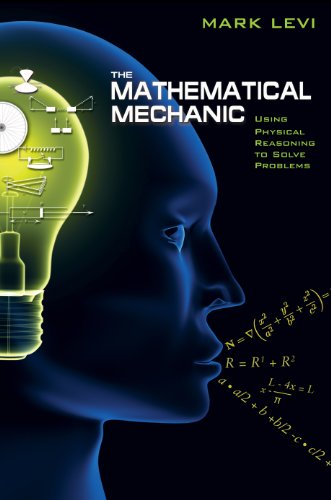
The Mathematical Mechanic, by Mark Levi

Get Free Ebook The Mathematical Mechanic, by Mark Levi
How if your day is started by reviewing a publication The Mathematical Mechanic, By Mark Levi Yet, it is in your device? Everybody will always touch and also us their gadget when waking up as well as in early morning activities. This is why, we expect you to also check out a book The Mathematical Mechanic, By Mark Levi If you still puzzled how to obtain the book for your gizmo, you can adhere to the means right here. As below, our company offer The Mathematical Mechanic, By Mark Levi in this internet site.
If you ally need such a referred The Mathematical Mechanic, By Mark Levi book that will certainly provide you value, get the most effective seller from us currently from lots of popular authors. If you want to entertaining books, many books, story, jokes, and a lot more fictions compilations are additionally launched, from best seller to one of the most current launched. You may not be confused to enjoy all book collections The Mathematical Mechanic, By Mark Levi that we will give. It is not regarding the rates. It's about just what you require currently. This The Mathematical Mechanic, By Mark Levi, as one of the very best sellers below will certainly be among the ideal options to read.
Discovering the appropriate The Mathematical Mechanic, By Mark Levi book as the appropriate necessity is sort of good lucks to have. To start your day or to finish your day in the evening, this The Mathematical Mechanic, By Mark Levi will certainly appertain enough. You could merely hunt for the floor tile below and you will certainly get the book The Mathematical Mechanic, By Mark Levi referred. It will certainly not trouble you to cut your useful time to go for buying book in store. In this way, you will likewise spend money to pay for transport and also various other time invested.
By downloading the on the internet The Mathematical Mechanic, By Mark Levi publication right here, you will obtain some advantages not to opt for the book store. Simply attach to the net and start to download and install the web page web link we share. Currently, your The Mathematical Mechanic, By Mark Levi is ready to take pleasure in reading. This is your time as well as your serenity to acquire all that you really want from this book The Mathematical Mechanic, By Mark Levi
Everybody knows that mathematics is indispensable to physics--imagine where we'd be today if Einstein and Newton didn't have the math to back up their ideas. But how many people realize that physics can be used to produce many astonishing and strikingly elegant solutions in mathematics? Mark Levi shows how in this delightful book, treating readers to a host of entertaining problems and mind-bending puzzlers that will amuse and inspire their inner physicist.
Levi turns math and physics upside down, revealing how physics can simplify proofs and lead to quicker solutions and new theorems, and how physical solutions can illustrate why results are true in ways lengthy mathematical calculations never can. Did you know it's possible to derive the Pythagorean theorem by spinning a fish tank filled with water? Or that soap film holds the key to determining the cheapest container for a given volume? Or that the line of best fit for a data set can be found using a mechanical contraption made from a rod and springs? Levi demonstrates how to use physical intuition to solve these and other fascinating math problems. More than half the problems can be tackled by anyone with precalculus and basic geometry, while the more challenging problems require some calculus. This one-of-a-kind book explains physics and math concepts where needed, and includes an informative appendix of physical principles.
The Mathematical Mechanic will appeal to anyone interested in the little-known connections between mathematics and physics and how both endeavors relate to the world around us.
- Sales Rank: #341067 in eBooks
- Published on: 2009-07-06
- Released on: 2009-07-06
- Format: Kindle eBook
Review
One of Amazon.com science editors' Top 10 list for Science, Best for 2009
One of Choice's Outstanding Academic Titles for 2009
"The Mathematical Mechanic documents novel ways of viewing physics as a method of understanding mathematics. Levi uses physical arguments as tools to conjecture about mathematical concepts before providing rigorous proofs. . . . The Mathematical Mechanic is an excellent display of creative, interdisciplinary problem-solving strategies. The author has explained complex concepts with simplicity, yet the mathematics is accurate."--Mathematics Teacher
"A most interesting book. . . . Many of the ideas in it could be used as motivational or illustrative examples to support the teaching of non-specialists, especially physicists and engineers. In conclusion--a thoroughly enjoyable and thought-provoking read."--Nigel Steele, London Mathematical Society Newsletter
"The Mathematical Mechanic reverses the usual interaction of mathematics and physics. . . . Careful study of Levi's book may train readers to think of physical companions to mathematical problems. . . . Mathematicians will find The Mathematical Mechanic provides exercise in new ways of thinking. Instructors will find it contains material to supplement mathematics courses, helping physically-minded students approach mathematics and helping mathematically-minded students appreciate physics."--John D. Cook, MAA Reviews
"Mark Levi reverses the old stereotype that math is merely a tool to aid physicists by showing that many questions in mathematics can be easily solved by interpreting them as physical problems. . . . Some sections of the book require readers to brush up on their calculus but Levi's clear explanations, witty footnotes, and fascinating insights make the extra effort painless."--SEED Magazine
"The book is chock-full of these seemingly magical physical thought experiments involving bicycle wheels, pistons, springs, soap films, pendulums, and electric circuits, with applications to geometry, maximization and minimization problems, inequalities, optics, integrals, and complex functions. . . . I highly recommend it to anyone who is (even slightly) interested in physics, and appreciates mathematical elegance and cleverness. It would make a great gift for almost anyone, whether a high school student or university professor, armchair physicist or professional mathematician."--Boris Yorgey, The Math Less Traveled
"The Mathematical Mechanic is a pleasant surprise."--E. Kincanon, Choice
"This is a delightful and unusual book that is a welcome addition to the literature. Certainly, any calculus teacher and many others of us as well will want to have it on the shelf for ready reference. It not only will enhance our teaching experience but will also teach us (the instructors) something in the process."--Steven G. Krantz, UMAP Journal
From the Back Cover
"What a fun book! Mark Levi's physical arguments are so clever and surprising that they made me laugh with pleasure, again and again. The Mathematical Mechanic is downright magical--a real treat for anyone who loves intuition."--Steven Strogatz, author of Sync: How Order Emerges from Chaos in the Universe, Nature, and Daily Life
"This is an absolutely delightful book, full of surprises--even for mathematicians like myself--and beautifully written. It can be enjoyed by anyone, from someone just learning calculus to professional mathematicians and physicists."--Louis Nirenberg, recipient of the National Medal of Science
"This is an extraordinary book that only Mark Levi could have written. No one interested in mathematics or physics can fail to be amazed and delighted. It is witty and charming as well as deep, and accessible with very little background required--a tour de force!"--Nancy Kopell, Boston University, MacArthur Fellow
"The most imaginative and charming book on mechanics and geometry in the last fifty years--for lighting up tea times, for thrilling classrooms, as a present for a special friend, as company on a desert island."--Tadashi Tokieda, University of Cambridge
"This book shows how many mathematical theorems can be proved by looking at them in mechanical or geometrical terms. I found it to be very interesting and fun to read. I recommend it most enthusiastically."--Joseph Keller, recipient of the National Medal of Science
"The Mathematical Mechanic jazzes up the old married couple, math and physics. The book breathes fresh air into the (sometimes stale) relationship and invites us to rethink familiar topics in unfamiliar ways. It disorients us in the most delightful manner. Mark Levi's razor-edge writing and gentle humor permeate every page. I will turn to this book again and again for inspiration on teaching math to high school students."--Gregory Somers, State College Area High School, recipient of the Edyth May Sliffe Award for Distinguished Mathematics Teaching
"This book is a fresh, insightful, and highly original presentation of mathematical physics that will appeal to a broad spectrum of readers. I have not seen anything like it before. It is a book that a physicist or engineer would be proud to have written, and the fact that it has been written by a mathematician only adds to the book's authority. A definite winner."--Paul J. Nahin, author of Digital Dice
"I know of no other book quite like this, or even similar to it. After a couple of sentences of the introduction, I was hooked. The general theme--to show how physical reasoning can illuminate mathematical ideas and simplify proofs--is very attractive. This book will appeal to math enthusiasts at all levels, from high-school students on up."--Philip Holmes, coauthor of Celestial Encounters
About the Author
Mark Levi is professor of mathematics at Pennsylvania State University and the author of Why Cats Land on Their Feet (Princeton).
Most helpful customer reviews
112 of 115 people found the following review helpful.
Two streams of thought are unified at last!
By Peter Haggstrom
Mark Levi's book "The Mathematical Mechanic" is a wonderful attempt to integrate physical reasoning with mathematical reasoning. These two strands have historically run in parallel and only occasionally have they been united at least at a pedagogical level. There seems to be a trend among Russian mathematicians particularly in the area of differential equations whereby they use physical reasoning to illuminate the more abstract mathematical approaches that are taken. V I Arnold is an example someone who has been known to integrate the two approaches. Perhaps Levi's Russian roots explain some of the impetus for this book. As mathematics becomes more and more specialised I fear that fewer mathematicians have the time or even inclination to think about the interconnections between physical reasoning and their own area. Levi's book is an antidote to that trend and he is to be congratulated for his efforts.
What Levy does is to take a large number of mathematical problems/theorems and show how physical reasoning using concepts such as conservation of energy, torque, resolution of forces, etc can be used to solve what are quite fundamental problems/theorems. In Chapter 2 he uses essentially torque concepts to prove the Pythagorean theorem be a thought experiment involving a right angled prism sitting in a water filled fish tank but attached to a spindle so it can rotate. The fact that it doesn't (ie there is zero net torque) leads directly to Pythagoras' Theorem.
Many of the problems turn upon one very basic physical principle and some careful reasoning about how that physical principle applies. For instance in working out why a triangle balances on the point of intersection of the medians the basic idea is a reductionist one and that is to conceptually slice a strip of the triangle. Since this strip balances and all the ones parallel to it will balance one can replicate the same argument for any other side and the point of balance will lie on the intersection of the medians. Levy spends a bit of time on geometrical optics and Fermat's principle and Snell's Law and gives a number of physical proofs for various formulas. There is that old favourite of saving a drowning victim by using Fermat's principle and this is explained in terms of Snell's law.
An interesting application of the general approach is to prove that the arithmetic mean is greater than the geometric mean by for throwing a switch. This all turns upon the concept of resistance along parallel paths and the result follows very quickly. Levy generalizes that approach to more complex arrangements. He covers Pappus Volume Theorem and applications of Ceva's Theorem. He also shows how you can compute the integral of sin x by using concepts of potential energy in the context of the movement of the pendulum. He touches on Hamiltonian mechanics and the Euler Lagrange equations and he even provides a hand waving proof of area preservation.
On page 125 there is a table of analogies between mechanics and analysis. For instance zero net work done is interpreted in an analytical sense in terms of preservation of the area. There is an interesting discussion of how an area preservation property can be viewed as a classical mechanical analog of the uncertainty principle in quantum mechanics. If an area preserving map squeezes some region about a point x we gain information about that point however because the map is area preserving it must stretch in the other direction (y) and this means that the range of values in the other direction is large so we lose information in that direction. If we think of the first variable x as signifying position and the second one being y which is identified with momentum, we then have the connection with the uncertainty principle.
I'm not aware of any other books that have systematically brought together this type of physical reasoning and its application to mathematical problems. In bringing together such a wide range of problems Levi has at the very least provided interested people with something to go on with in a more systematic fashion. The beauty of the book is that often a compelling physical reason for a particular mathematical equation can be much easier to remember and can actually illuminate the mathematical proof. One could even contemplate a little subculture of mathematics developing whereby people try to develop more and more inspired physical analogies for various mathematical theorems.
Levy does not assume a great level of mathematical sophistication however readers should have a reasonable grasp of basic concepts such as the resolution of forces, potential energy, kinetic energy and how the can be applied to a problem. There is no heavy-duty calculus or analysis involved and Levy has a very informal and chatty style.
I recommend this book without any reservation - it should have been written many years ago. I think students will find it enriches their understanding of the concepts.
17 of 18 people found the following review helpful.
What if Pythagoras had met Newton?
By Joseph Horton
I loved geometry, thought it was the greatest thing since forever. The way I proved theorems was to visualize the constructs in motion. It made the stuff come alive for me, and I saw relationships that, well, others didn't seem to appreciate.
Levi does this over and over again, but instead of merely making moving parts, he assigns the physical to what is otherwise purely mathematical. In addition to the stroll down the memory lane of my thought processes--and a reassurance that at least one other person the universe does this as well--it showed a few new ways of looking at commonplace things--like Pythagoras' theorem. He proves it using torques--torques?????--yeah, torques. Yet another proof involves concentric circles. Just read it--it's clever as anything. I grant you that I had to look at most of the analogies a couple times to get them, but get them I did.
It's a great way to spend a few hours. My bet is that this will be most useful to math and physics teachers. Is everything about physics and math intuitive? Certainly not, but enough is that having a strong sense of it is useful. It took my intuition to the next level.
1 of 1 people found the following review helpful.
MATH, PHYSICS AND MECHANICS - SUCH BEAUTY
By Jairo Ap Martins
The idea of bringing conceptual math with physics and mechanics is worth. The world is visual and mechanical therefore some apparently hidden concepts in math are explored in a didactic and relevent way. Even if you do not have the math basic concepts in your mind you are able to visualize the math/physics concepts mentally within minimal efforts. As a Professor I am going to consider the systems shown in the book in my classes.
The Mathematical Mechanic, by Mark Levi PDF
The Mathematical Mechanic, by Mark Levi EPub
The Mathematical Mechanic, by Mark Levi Doc
The Mathematical Mechanic, by Mark Levi iBooks
The Mathematical Mechanic, by Mark Levi rtf
The Mathematical Mechanic, by Mark Levi Mobipocket
The Mathematical Mechanic, by Mark Levi Kindle

Tidak ada komentar:
Posting Komentar